 Governance as a Service
Because AI agents don't
have an undo button.
We built a governance pipeline that sits between AI agent intent and execution — every consequential action is checked against policy and allowed, held, or blocked before it fires, with an immutable audit record. Sub-100ms for routine actions.
 GaaS Pipeline
Intent Declaration
Context Enrichment
Policy Evaluation
Multi-Agent Deliberation
Decision + Audit
Recent Decisions
48,293
Decisions Tracked
87.3%
Approval Rate
74ms
Avg Latency
 Explore at gaas.is
THE PIPELINE
Five stages. One decision.
Intent Declaration
Agent declares intended action
Context Enrichment
System discovers missing context
Policy Evaluation
60 policies across 11 categories, four-tier hierarchy
Multi-Agent Deliberation
6-agent LLM panel debates high-risk actions
Decision + Audit
SHA-256 hash-chained, immutable audit record
Intent Declaration
Agent declares intended action
Context Enrichment
System discovers missing context
Policy Evaluation
60 policies across 11 categories, four-tier hierarchy
Multi-Agent Deliberation
6-agent LLM panel debates high-risk actions
Decision + Audit
SHA-256 hash-chained, immutable audit record
CAPABILITIES
Everything agents need to behave.
Bidirectional Governance
Outbound agent control + inbound protection
Trust Tiers
Registered, Verified, Certified credentialing
Shadow Mode
Observe without enforcement
27 Native Connectors
Twilio, Salesforce, Stripe, GitHub, Okta, Slack & more
SDK Support
Python, TypeScript, Java
Framework Plugins
LangChain, AutoGen, CrewAI
COMPLIANCE
Regulation-ready by design.
Compliance isn't a feature we bolted on — it's the discipline H2Om built its reputation on. Years of shipping HIPAA, SOC 2, and PCI DSS software for healthcare, defense, and enterprise taught us exactly what auditors ask for. GaaS is what that expertise looks like as a product.
Every consequential agent action is checked against policy before it executes — allowed, held, or blocked — and every decision lands in an immutable, SHA-256 hash-chained audit record. That's the working definition of Governance as a Service: the governance layer lives outside the agent, so the evidence stands on its own.
Controls map out of the box to 12 regulatory frameworks, including the EU AI Act, GDPR, HIPAA, PCI DSS, and SOC 2 — with implementation details in the developer docs.
IN PRODUCTION
Running live. Right now.
GaaS isn't a roadmap — it's deployed. The pipeline architecture, the quickstart, the regulator-ready compliance mappings: all live, all public.
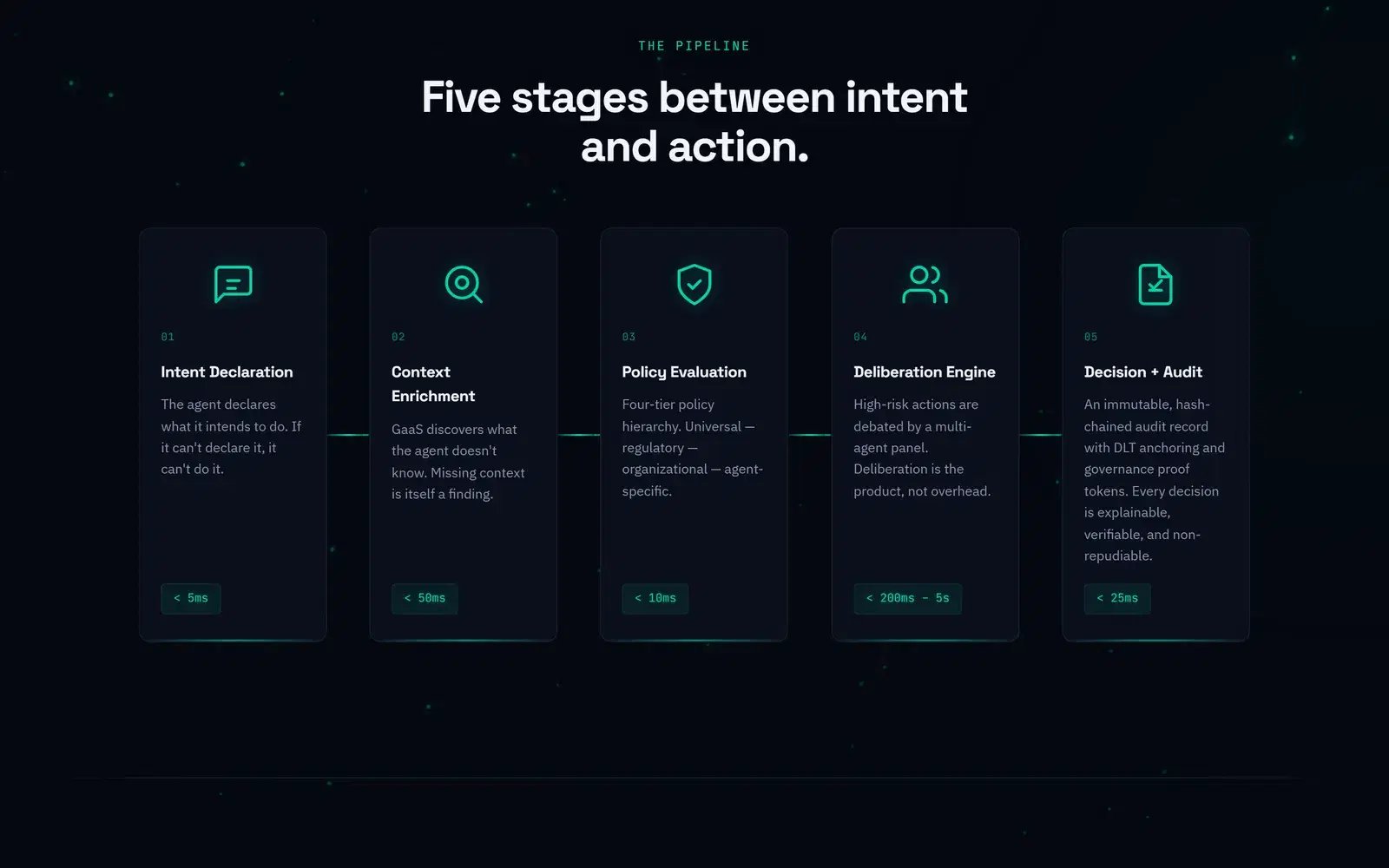
The governance pipeline
Five stages between intent and action — Intent Declaration, Context Enrichment, Policy Evaluation, Deliberation Engine, Decision + Audit — each with its latency budget.
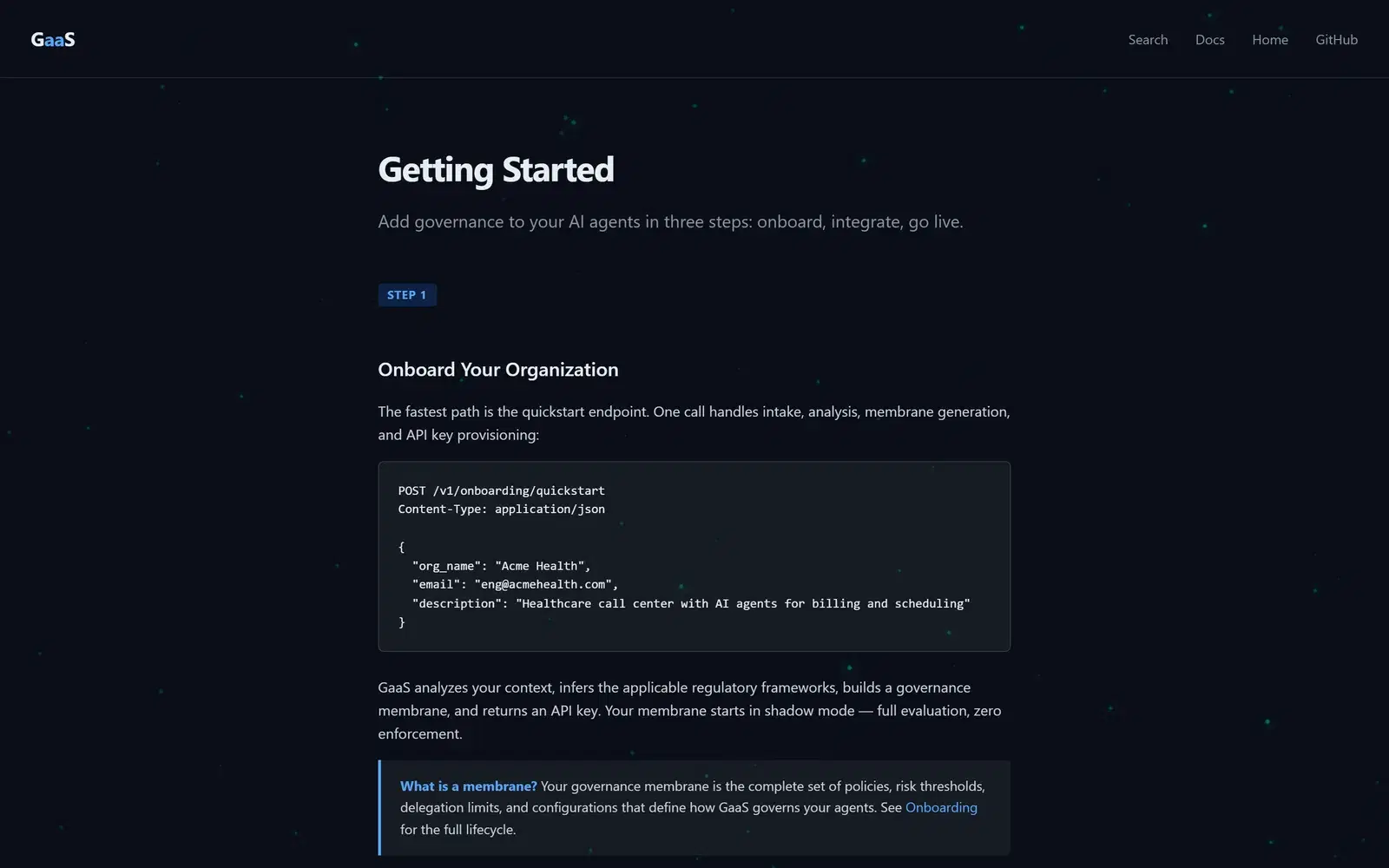
Three steps to governed
One quickstart call provisions your governance membrane and API key — starting in shadow mode. pip install gaas-sdk and go.
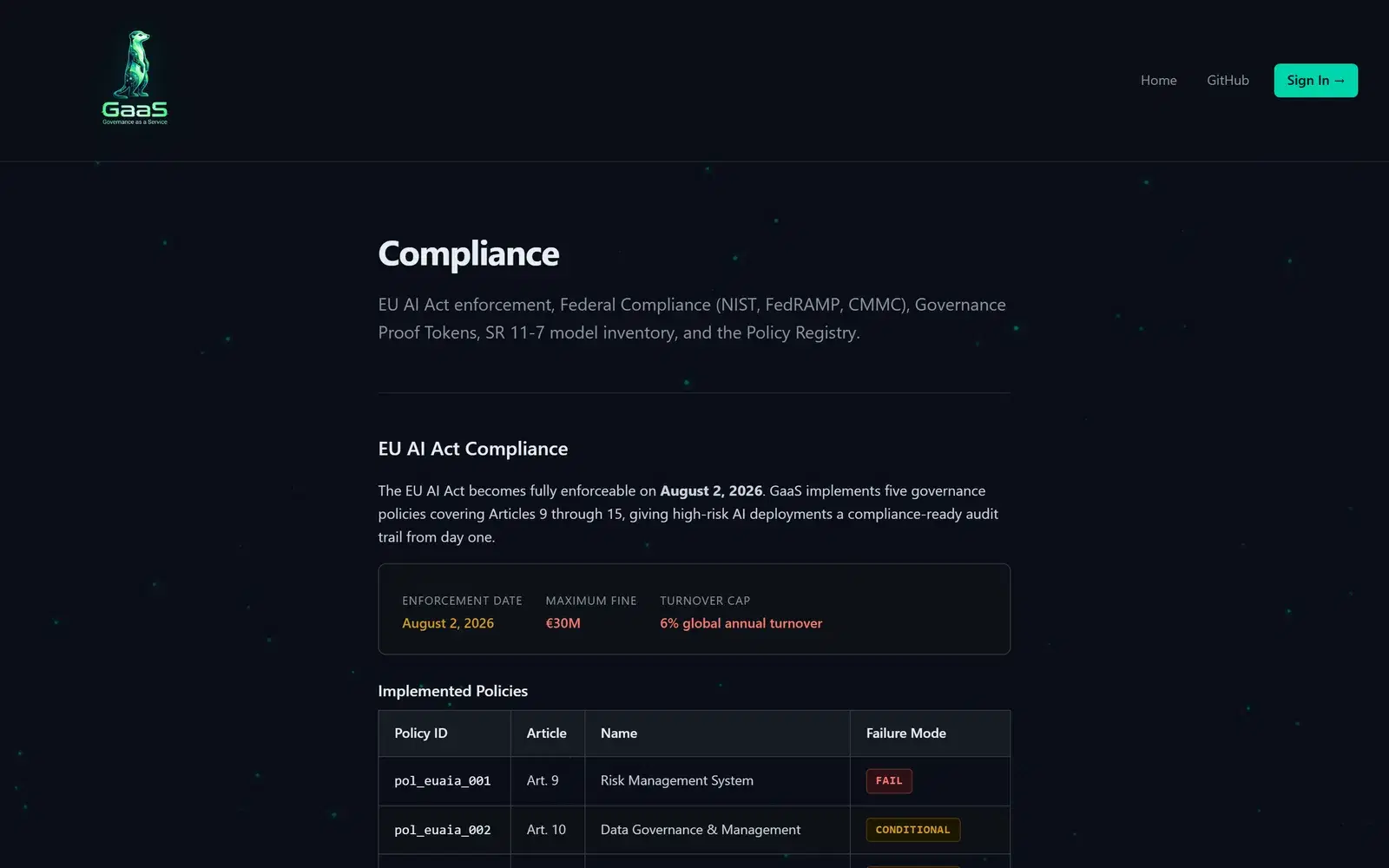
Compliance, documented
EU AI Act policies mapped article by article, federal frameworks (NIST, FedRAMP, CMMC), and governance proof tokens — evidence a regulator can read.
PHILOSOPHY
Built on first principles.
The agent is not the governor
Architectural separation of concerns
Fail-Safe Design
Blocks rather than silently passes on governance failure
Risk-Proportional Speed
Sub-100ms routine; up to 10 seconds for deliberation
Complete Auditability
SHA-256 hash-chained, immutable records with full reasoning chains
The Context Dividend
How externalizing governance returns the scarcest resource in AI — and seven other things you didn't know you were missing. 58 pages of quantitative analysis, architecture detail, and regulatory strategy.
Download White Paper (PDF)Version 3.0 · February 2026 · H2Om Technologies
We built GaaS to control AI Agents
and make them accountable.